Under the Same Sky
Flinders Lane Gallery
Melbourne
2026
 Jo Davenport The Colour of Rain, 2026 Oil on Belgian linen 150cm x 150cm Photo: Jules Boag, 2026 |  Jo Davenport Mirror, Mirror, 2026 150cm x 150cm Oil on Belgian linen Photo: Jules Boag, 2026 |
|---|---|
 Jo Davenport Eco's in Pink and Blue, 2026 Oil on Belgian linen 90 cm x 90 cm Photo: Jules Boag, 2026 |  Jo Davenport Wild Apple Blossom, 2026 Oli on Belgian linen 90 x 90 cm Photo: Jules Boag, 2026 |
 Jo Davenport Spring and the Westwind, 2026 Oli on Belgian linen 90 x 90 cm Photo: Jules Boag, 2026 | 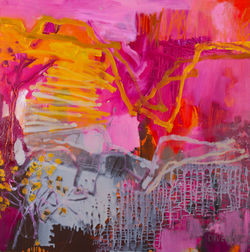 Jo Davenport Moonlight and Love Song, 2026 Oli on Belgian linen 90 x 90 cm Photo: Jules Boag, 2026 |
 Jo Davenport A Mirrored Sky, 2026 Oli on Belgian linen 90 x 90 cm Photo: Jules Boag, 2026 |  Jo Davenport Pink Sky at Night, 2026 Oli on Belgian linen 90 x 90 cm Photo: Jules Boag, 2026 |
 Jo Davenport Titanium Yellow, 2026 Oli on Belgian linen 90 x 90 cm Photo: Jules Boag, 2026 | 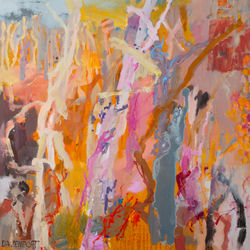 Jo Davenport Golden Hour, 2026 Oli on Belgian linen 90 x 90 cm Photo: Jules Boag, 2026 |
Under the Same Sky
Flinders Lane Gallery, Melbourne
4 - 20 November 2026
There’s hardly a thing to see in terms of human habitation, but much to contemplate where water, trees, shadows, animals and light are concerned. The atmosphere is constantly breathing new expressions into the surroundings, with mists, dry air, glare and the golden hour at dusk taking their turns. This is what is commonly referred to as a landscape, but it is more than that.
For someone whose extensive art education has taken in practical, technical skills acquired at the Riverina Institute of TAFE, Charles Sturt University and Albury Technical College, along with a more theoretical and contemplative approach during a Masters at the Victorian College of the Arts, experimentation has always remained a constant for Davenport. She is nimble, slipping easily from one way of working to another, with curiosity and energy, and an extensive toolbox of methodologies.
In the forests she visits, there is an accumulation of leaves and soil and other organic detritus, just as the daily atmospheric currents fold over and intermingle through that environment. Below all this are the sediments of rocks, long-cooled magma, mantles and seams that have built up over an aeon. Likewise, Davenport works in layers: stratum upon stratum of thinned-out oil paints that gradually accrue to form a whole. She usually works on the floor, the canvas flat, like a bedrock. The paintings might be described as landscapes – certainly they strongly reference Davenport’s locale and her experiences within it – but it might be more apt to imagine her works as inhabiting that interesting space that exists between the surface of the painting and the eye of the viewer. What goes on in that unseeable zone? As John Berger once observed, when we ‘see’ a landscape, we situate ourselves within it. Detachment dissolves.
Davenport provides some guidance, investigating what happens when eye and mind encounter the splendour and awe of the natural world. This closely aligns with an Australian Indigenous approach to the world, where Country is neither place, nature nor environment, simply because there is no clear separation between humans, their goings-on and the plants, animals, rocks, air and water.
Stand before Davenport’s The Colour of Rain, for example, and it seems as if that world can be walked into for a felt experience of colour and water. Any sense of realism (realism of the photographic type) is far in the distance. Here, there is the texture of an environment in which ‘rain’ is not neutral and transparent liquid, nor an objective reality, but something far more subjective. In this instance, it is tempered by feeling – another word that, like landscape, is difficult to pin down. Davenport, whose growing up years were a constant experience of immersion, always spending time outdoors and hiking, snorkelling, beachcombing and climbing, does not try to find concrete terms: her work is not topographical, and it eschews the abstract, but it does envelop.
It is no surprise, then, that her studio looks straight into the bush: the hills reflecting late afternoon light and the gloaming; foxes coming right up to the kitchen window; astonishingly busy bird-life; kangaroos by the hundred; a bright pink sky; an enigmatic mist. Every day is different, as each of Davenport’s richly layered paintings is a new beginning.
- Andrew Stephens, 2026